

Fitness Trails vs. Outdoor Fitness Parks: Why More Cities Are Choosing Fitness Clusters
Historically, when it comes to outdoor fitness equipment in a park, fitness trails were considered the standard. The public could walk or jog along a trail and make occasional stops at a single-user exercise station to perform pull-ups, push-ups, dips, or other bodyweight exercises before continuing along the trail to the next station.
Recently, there has been a shift as municipalities are increasingly moving away from this design in favor of sites with outdoor fitness equipment clustered together, traditionally at the head of a trail. These centralized outdoor fitness parks provide a number of advantages, and in this blog we’ll highlight some of the biggest pros of a fitness cluster vs a fitness trail.
An Outdoor Fitness Park That Replicates an Indoor Commercial Gym
The biggest reason why municipalities have begun to adapt fitness clusters is that they replicate the familiar layout of an indoor commercial gym and mirror how people naturally prefer to exercise.
When you walk into the gym, you are usually met by treadmills and other cardio devices, and as you walk further in, you’ll find yourself surrounded by strength training equipment. Keeping cardio and strength training close but not scattered throughout. No one would walk a quarter mile on a treadmill, then do a set of pull-ups, then walk another quarter mile, and hit the bench press, so why should an outdoor fitness park be any different?
Fitness clusters bring this proven layout outdoors. Adjustable strength training equipment like the Pro-Drives or the Apollo Multigym, bodyweight strength training equipment like the Cali-Line or the Spartan Multigym, and flexibility training equipment like the Flex Multi-Stretch can all be placed together within a compact footprint, allowing users to perform efficient workouts and then go for a walk or run along the trail, rather than scattering their exercises over the course of the trail.
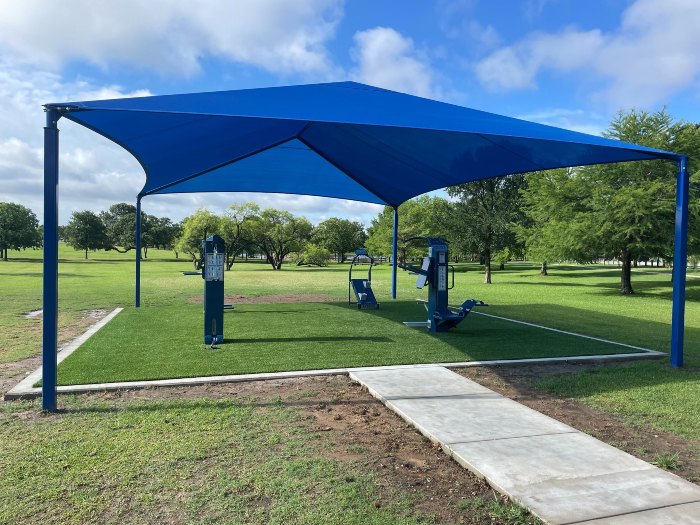
Better Lighting, Visibility, and Safety in Outdoor Fitness Parks
Since fitness clusters are centralized at the head of a trail, lighting is typically better because there are no individual stations hidden beneath the trees or out of the public eye. Improved lighting increases visibility, attracts new users to try the equipment, and creates a safer environment for park visitors. Fitness clusters at the head of the trail are usually near other park amenities, such as a playground or basketball court, so adults can easily exercise while watching their kids play. The increased visibility and nearby amenities can lead to greater public surveillance of the equipment, which lowers the risk of vandalism or misuse of the outdoor fitness equipment.
Lower Installation Costs
When municipalities are planning a new outdoor fitness park, they want the main focus and the majority of the funds to go towards the outdoor fitness equipment and supporting amenities, and not the site prep and installation costs. Fitness trails with multiple sites require multiple concrete pads and multiple areas for safety surfacing, creating a higher overall project cost.
On the other side of this is a fitness cluster, where outdoor fitness equipment can be installed within a single area, reducing site prep and installation time, and making sure that municipalities can focus their funds on higher-quality outdoor fitness equipment and not feel like they’re spending too much on the install that comes with it.
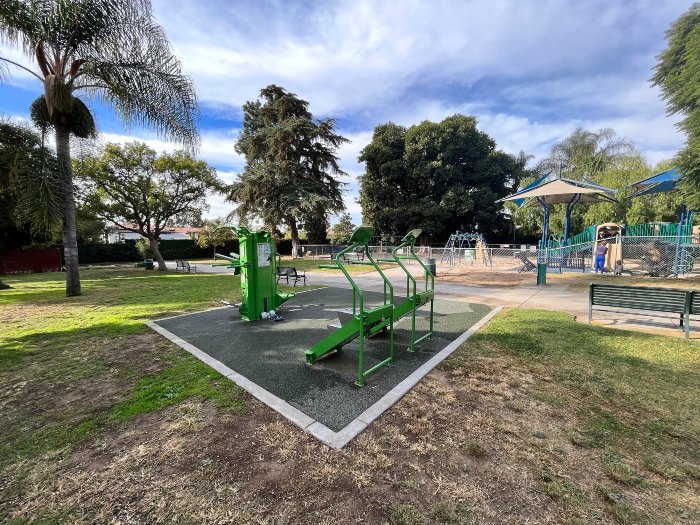
Planning a New Outdoor Fitness Park?
Whether you're planning a traditional fitness trail or a centralized outdoor fitness park, our team can help you design a solution that fits your space, budget, and community goals. Contact our team today to learn more about our commercial outdoor fitness equipment and start planning an outdoor fitness park your community will enjoy for years to come.
Frequently Asked Questions About Outdoor Fitness Parks and Fitness Trails
Yes. Outdoor-Fit offers compact outdoor fitness equipment, including multigyms that provide a full-body workout within a single footprint. These systems are ideal for parks, schools, municipalities, and recreation areas where space is limited.
Absolutely. While many communities are choosing centralized outdoor fitness parks, we also design traditional fitness trails using strategically placed outdoor exercise equipment that meets your project's goals and available space.
A fitness trail spreads individual exercise stations along a walking path, while an outdoor fitness park groups outdoor gym equipment together in one location. Fitness parks create a more efficient workout experience, improve visibility, reduce installation costs, and encourage greater community use.
Many municipalities are moving toward outdoor fitness clusters because they provide a gym-like experience, improve supervision and lighting, reduce installation costs, and make outdoor fitness equipment easier to maintain and access.
A balanced outdoor fitness park often includes strength training equipment, bodyweight workout stations, stretching equipment, and accessible exercise options. Combining different equipment types allows users of varying fitness levels to complete full-body workouts in one location.